உ
சிவமயம்
SANTHASWAMY

Birth name Hon James Ramsbotham
Date of birth:21-3-1915
Education: Eaton College (near Windsor), Berkshire, England. He was captain of his house. From Eaton he entered Magdalene College, Oxford University.
After graduation, he started work in an export – import company, City of London. In Oxford, he was with a group of clever and witty companions at Magdalen culturally matured and connected; elitism of a kind.
He had already begun his restless search for a less conventional way of life. He had decided to study philosophy as the great guide to explaining “truth”. But he could not find the answers to his questions and he embarked his search and he did not care about anybody who did not have the same interests. As a seeker of spiritual knowledge, he travelled in Europe. While he was studying in Germany he was introduced to a group, who were following a remarkable Russian Teacher. Their work was to be kept secret as it was esoteric in character. It offered practical ways of thinking, behaving and perceiving the rough self-
observation and awareness to escape from the conflicting egos inside one and form ceaseless imaginings and identification.
Following the exacting requirements of those methods, he changes his way of life. And this included leaving the export and import company, so that he could direct his concentration on this work.
At the outbreak of the war, instead of joining up with his Oxford friends in the regiment or the guards to serve in units overseas, he signed up with Royal Electrical and Mechanical Engineers (REME), rapidly mastering the professional techniques, so that he could continue his work with the groups in England. At the end of the war, he followed his teacher to America and later escorted him back to England, where his teacher died.
James Ramsbotham continued to guide and teach groups in the same way. And this is how he met his wife Anthena, who with her mother had been attracted to the same teaching. They were wonderfully happy together with Anthena sharing so many of James Ramsbotham’s hopes and aspirations.
A year or so after their marriage in 1949, she died along with her son at childbirth.
James Ramsbotham visited Ceylon in 1950. During this visit, he spent some time with his
German friend known as Gowribala, who had set up a hermitage at Selva Sannithy, in Jaffna. In 1953, Gowribala (Geman Swamy) introduced James Ramsbotham to Yogaswamy as the son of the Governor General. Yogaswamy greeted him and said, “I am your Governor and your General”. In 1955, James Ramsbotham paid a visit to Markandu Swamy in Kaithadi, Jaffna. During this period, James Ramsbotham stayed in places like Selva Sannithy (North of Ceylon) and Kataragama (South of Ceylon) famous for the Murugan Temple.
In 1957, James Ramsbotham returned to England and was planning to Join the Greek Orthodox Church. He had already paid several visits to Mt. Athos. The day before the ceremony, Yogaswamy sent a message to James Ramsbotham via Gowribala (German Swamy). Yogaswamy’s message was enough to prompt him to cancel the ceremony the next day. He abandoned the religious direction of faith and went to Ceylon to pursue his search to know the “Truth” and for guidance for a true belief. When James Ramsbotham returned to Yogaswamy in Columbuthurai Ashram, Yogaswamy asked him, “IS THERE NO GOD IN LONDON?”
Yogaswamy made arrangements for James Ramsbotham to stay in the Sivathondan Nilayam, Jaffna. He stayed in the Sivathondan Nilayam performing meditation for a period.
1959 James Ramsbotham went back to England.
1960 James Ramsbotham returned to Ceylon
1961 Brought the wheel chair for Yogaswamy to move around Jaffna.
30-12-1963 James Ramsbotham was initiated by Yogaswamy in his Columbuthurai Ashram with the following words: “From today onwards you are a Sanyasi and your name is Santhaswamy.” This day was the (ஆருத்திரா தருசனம் – திருவாதிரை ) day on which saint
Manicavasagar became one with God (ஆருத்திராதரிசனம்)- இரண்டறக் கலப்பு a special religious ceremony was performed to James Ramsbotham by Eswaran following all the instructions from Yogaswamy.
After the ceremony, 10 people attended the lunch in the Ashram.
Yogaswamy’s Maha Samathy was on 23-3-1964.
The foundation for CHENKALADY SIVATHONDAN NILAYAM took place in 1964.
The Sivathondan Nilayam was established and fully operational on 14-3-1965, which coincided with Yogaswamy’s first anniversary Maha Samathy Ayillium day.
For the consecration of the Sivathondan Nilayam in Chenkaldy, THIRUVADI was taken from Jaffna on 13-3-1965 by Santhaswamy, arriving in Chenkalady on 14-3-1965. Santhaswamy was very much instrumental in realising this institution, which can be seen as a living monument to his untiring efforts.
The surroundings of the Sivathondan Nilayam in Chenkalady are blessed with flowers, fruit and vegetable gardens and fields of coconut trees along with herds of cows to provide the required materials for the regular daily poojahs in the Sivathondan Nilayam.
Daily poojahs, Sivapuranam, Thirumurai, Natchinthanai, Sanskrit sloga recitals take place, in a manner similar to what happens in Jaffna Sivathondan Nilayam.
Every third Sunday of the month is designated as a Yoga Day, when meditation is the main observance of the day. This would end with the distribution of prasaadam to all devotees. This Sivathondan Nilayam was set up to encourage the young and old towards the path of self-help, duty and salvation. Santhaswamy himself got involved in paddy cultivation and helped to educate youth in farming practices and self-discipline.
Santhaswamy constructed a small Ashram in close proximity to the Sivathondan Nilayam for his stay. The produce from the fields were distributed to the needy. Santhaswamy spent approximately 14 years (till the sixth of May 1977) in Chenkaladi. During this period, he translated a good portion of Yogaswamy’s Natchinthanai from Tamil to English under the title of “Songs and Sayings of Yogaswamy.” His erudite knowledge of Vedanta, Siddhanta, the Yoga Shastras and other scriptures of the Hindus, his study of Tamil Language and his metrical knowledge of same, helped him in this venture.
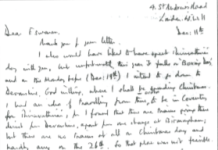
While Santhaswamy was in Chenkaladi, he wrote a letter explaining to his nephew in England, who asked about the purpose of the Sivathondan Farm at Chenkaladi, Ceylon. This is given on Santhaswamy had the Ladies’ Ashram at Columbuthurai built in 1970. This was set up to help ladies to strive to lead a life that is independent and self-fulfilling, while strengthening their religious beliefs.
In 1971 Santhaswamy’s father, Viscount Soulbury died and Santhaswamy inherited the title of Viscount Soulbury.
His knowledge of Tamil enabled him to contribute some memorable words about Yogaswamy for the Sivathondan special publication in 1965. The translation of which is as follows:
“Is it possible for me to put in words taught about the Lord who has no equal?”
On 6th May 1977 Santhaswamy left Chenkaladi after establishing Sivathondan Nilayam in the Eastern Province, handing over both the Ladies’ Ashram and the Sivathondan Nilayam to be managed by the Sivathondan Committee of honorary members. These institutions are flourishing to this day and remind us of Santhaswamy’s loving devotion and great service.
After some months in England, he returned on 5th December 1978 at Markandy swamy’s invitation to Kaithadi in North Ceylon to do Tapas with him. On 14th May 1984, 6 years later he returned to England.
Markanduswamy attained Samathy on 29th May 1984.
1984-1986
On his return to England, Santhaswamy was staying in his ancestral property in Ovington, Winchester, with his brother Sir Peter Ramsbotham. When Sir Peter Ramsbotham remarried in 1986, Santhaswamy built a small Ashram on the same land, with facilities self-contained and stayed separately.
Santhaswamy published “A Recapitulation of the Lord’s Prayer” the only work of his own that he wished to present for wider reading. It was printed in 1985 by Alresford Press, distributed by Element Books and anonymously published by “J P Ross” standing for Joan, Peter Ramsbotham, O’Grady and Soulbury Scripsunt. Santhaswamy wished to recapture this important prayer for our age. His profound knowledge of the gospels was brought to bear on his studies across denominations and inter-faith barriers – with insight into the mystical writings of Christian, Jewish, Buddhist, Hindu and Sufi traditions. All to support and clarify to readers his devotion to Christ.
Santhaswamy gave full recognition to his family’s contributions in the publication of the book. Santhaswamy kept himself absorbed in his work and at peace at his Ashram. He was admired by many in the village who would see this purposeful figure on his daily walks in the country lanes. In 1993 “Positive thoughts for Daily Meditation” was published by Santhaswamy.
1986-1998
Santhaswamy continued his stay in his Ashram, while travelling to selected places and he had realised in his self what he had been searching for all the time. He kept himself quietly at work and in peace in his Ashram.
Santhaswamy was admitted to Cottage Nursing Home in 1998.
I was able to provide all the support that I gave Appu (Yogaswamy) during his last days.
We went on long drives in the evening around the country, which he enjoyed very much. On Moolam (மூலம்) day Santhaswamy attained Samathy on 12-12-2004. I sang all the Natchinthanai songs and Sanskrit songs which I learnt from Appu and sat with Sir Peter to discuss Santhaswamy’s final journey details. On 23-12-2004 between 10 am and 10.45 am Santhaswamy’s body was prepared to resemble his initiation day appearance on 30-12- 1963.
Prayers with Sivapuranam, Natchinthanai and Sanskrit slogams were recited in Winchester, Hampshire. The Church service was conducted in the family church from 11.30am in Ovington, Alresford, Hampshire. Cremation was at 3.45 pm in Basingstoke Crematorium, Hampshire. At 7.30 am, on 25.12.2004, as per Santhaswamy’s wishes the holy ash was dispersed at a particular location in the river Thames, London. Regular monthly Moolam and Annual Guru Poojas take place in Birmingham.

TRIBUTE BY SIR PETER RAMSBOTHAM 23.12.2004
James Herwald Ramsbotham.
Tribute by Peter Ramsbotham
23-12-04
We have come to say farewell to my brother Jim. He spent many years abroad, but always kept a close and loving relationship with our respective families, in their different generations. And even though some of you could not often be with him, you have I know, held him in fond admiration for his warmth and kindness.
So I shall tell you something of the earlier years of his life before he found his way to Sri Lanka – where he lived and worked for some thirty years – and then, when he came home in 1983, to stay with me in Ovington.
For my sister Joan and myself, he was always very much the elder brother – a continuing and important influence in our lives.
We were a closely knit triumvirate, from the nursery days onwards: a happy childhood, with wonderful parents; two years between the three of us, with myself bringing up the rear, and Jim always the natural leader; staying especially near to his devoted sister, who would enjoy playing with me until he came back from boarding school in the holidays, when I had to scurry very hard to keep up!
For me, he was the kindest older brother – happily tolerating the gap of four and a half years between us; the liveliest of spirits and very funny. We shared bedrooms at Kingswood and in Lindisfarne. We went on amusing expeditions to explore unusual country houses. In 1938 he joined me in France, when I was 18. I’d bought a 5hp open Citroen – a sabot – and we toured through Burgundy and Auvergne. Our visits to medieval churches were interspersed with delicious meals and local wines.
The close relationship between the three of us stayed undiminished by our dispersals during the war and then separated at times; Jim in Sri Lanka, Joan in America and myself being posted abroad in the Foreign Service. It made no difference. We told each other about our lives and our thoughts in letters. There was a remarkable and continuing correspondence between Jim and Joan on the spiritual and psychological subjects that mattered to them.
For that became the mark and pattern of Jim’s life. Until his early twenties it could be said that his life was cheerfully conventional. He had all the necessary and family background; a first-class mind and a natural capacity to win friends and admirers. Already something of a star at Eton physically strong, athletic – he won his spurs in the sporting fields: Captain of the House; in Pop; in fact, doing all the proper things for a successful Etonian in those days.
And the same at Oxford with a group of clever and witty companions at Magdalen; culturally mature and well connected; an elitism of a kind, I suppose.